
Buying Guide
Here you will find everything you need to know about our CP ski helmets and visor helmets. Learn how to determine the right helmet size, which fit suits your head shape, and what distinguishes our various helmet and shell materials. We also explain the differences between our visors, safety systems, and equipment options – so that you can find the CP helmet that is a perfect match for you.
Everything you need to know about our helmets
Which helmet fits my head shape
The CP Corao+ and Coya+ feature a slightly narrower fit in the upper head area due to the integrated ODSA Safety System. The models are therefore particularly well-suited for narrower to oval head shapes.
If you are between two sizes or require a little more space in the upper head area, we recommend choosing one size larger. The helmet can then be individually adjusted to your head using the size adjustment system.
The CP Curano+ is characterized by a balanced and comfortable fit, making it suitable for both round and oval head shapes. As a result, the model offers a pleasant and uniform fit for many different head shapes.
You can further customize the fit to your head circumference using the integrated size adjustment. The Curano+ is therefore a great choice if you are looking for a versatile and comfortable fit.
The CP Carachillo stands for a particularly slim and close-fitting helmet shape. Thanks to its compact construction, the helmet is low-profile and creates a sporty, understated silhouette.
The integrated size adjustment allows the helmet to be individually adapted to the circumference of the head. It is particularly important with the Carachillo that the helmet sits evenly on the head and does not create any uncomfortable pressure points.
The CP Camurai & Cuma combine a sporty helmet shape with a comfortable, close-to-the-body fit. The helmet sits compactly on the head and is particularly suitable for skiers who prefer a sporty fit.
Thanks to the size adjustment, the Camurai can be individually adapted to your head circumference. It is crucial for the correct size that the helmet sits securely and evenly without exerting unpleasant pressure at any individual points.
The CP Carachillo XS Kids has been specifically designed for smaller heads, offering children a compact and comfortable fit. We recommend this model for children from about 6 years of age – however, the actual head circumference is always the deciding factor for selection.
The helmet can be individually adjusted using the size adjustment system. For a secure fit, the children's helmet should sit snugly and evenly on the head without causing pressure points.
How do I measure my head correctly
The right helmet size starts with the correct head circumference. To determine your appropriate ski helmet size, you only need a flexible tape measure.
Place the tape measure horizontally around your head, about 1–2 cm above your eyebrows and ears. Then guide it around the widest point at the back of your head and back to your forehead. The tape measure should fit snugly against your head, but not cut into it.
The measured value in centimeters corresponds to your head circumference and serves as the basis for choosing your CP helmet size.
Tip: It is best to measure your head circumference two or three times to rule out measuring errors. If you are exactly between two sizes, you should also consider the fit of the respective helmet model. Some CP models have a slightly narrower fit at the top of the head than others.
A properly adjusted ski helmet should sit evenly and securely on your head without causing uncomfortable pressure points. If the helmet moves significantly when you shake your head, it is generally too big.
Which visor fits my helmet
With CP, you don't need to worry about whether a visor fits your helmet size. Thanks to our patented visor exchange system, our visors are size-independent and can be used on all compatible CP visor helmets from size S to XL. This allows you to easily swap your visor and adapt your helmet to different light conditions or your personal style at any time.
When choosing your visor, you can select between three quality levels:
Single Lens – the uncomplicated entry-level option
Our Single Lens visors consist of a single lens and feature an anti-fog coating. Depending on the version, they are available in different tints as well as with a mirrored finish.
Click here for Single Lens visors
Photochromic Double Lens – automatic adaptation to light
The next level is our Photochromic Double Lens visor. The double-lens construction improves anti-fog performance and ensures high visual comfort. Additionally, the photochromic lens reacts to light conditions: the visor automatically darkens in stronger sunlight and becomes lighter again in lower light conditions.
Click here for Photochromic visors
Polarised + Photochromic Double Lens – maximum visual performance
Our highest visor quality combines the features of the Photochromic Double Lens visor with added polarization. This reduces distracting reflections and glare while improving contrast perception. Especially in changing or difficult light conditions, contours and variations in the snow surface can be perceived more clearly as a result.
Click here for Polarised visors
Carachillo XS visors are slightly smaller and therefore do not fit adult helmets.
Click here for Carachillo XS Kids visors
Two visor shapes: 1.6 or 2.7
In addition to the visor quality, CP also allows you to choose between two different visor shapes. Both versions are compatible with our visor exchange system – the difference lies primarily in the shape and thus the look of the helmet.
Visor 1.6 – round and generous
The CP 1.6 visor is slightly larger and more rounded. Its curved shape creates a classic, generous visor aesthetic.
Visor 2.7 – flat and modern
The CP 2.7 visor features a straighter shape with a flat bottom edge. This gives the visor a more modern and slightly edgier appearance.
Which shape you prefer is ultimately a matter of personal taste. Thanks to our patented system, you can constantly give your CP helmet a new look with different visor shapes, colors, and mirror finishes.
All visor qualities are available in various colors, tints, and mirror finishes. This allows you to choose your CP visor to match your desired optical properties, your helmet, and your personal style.
What are the advantages of a visor helmet
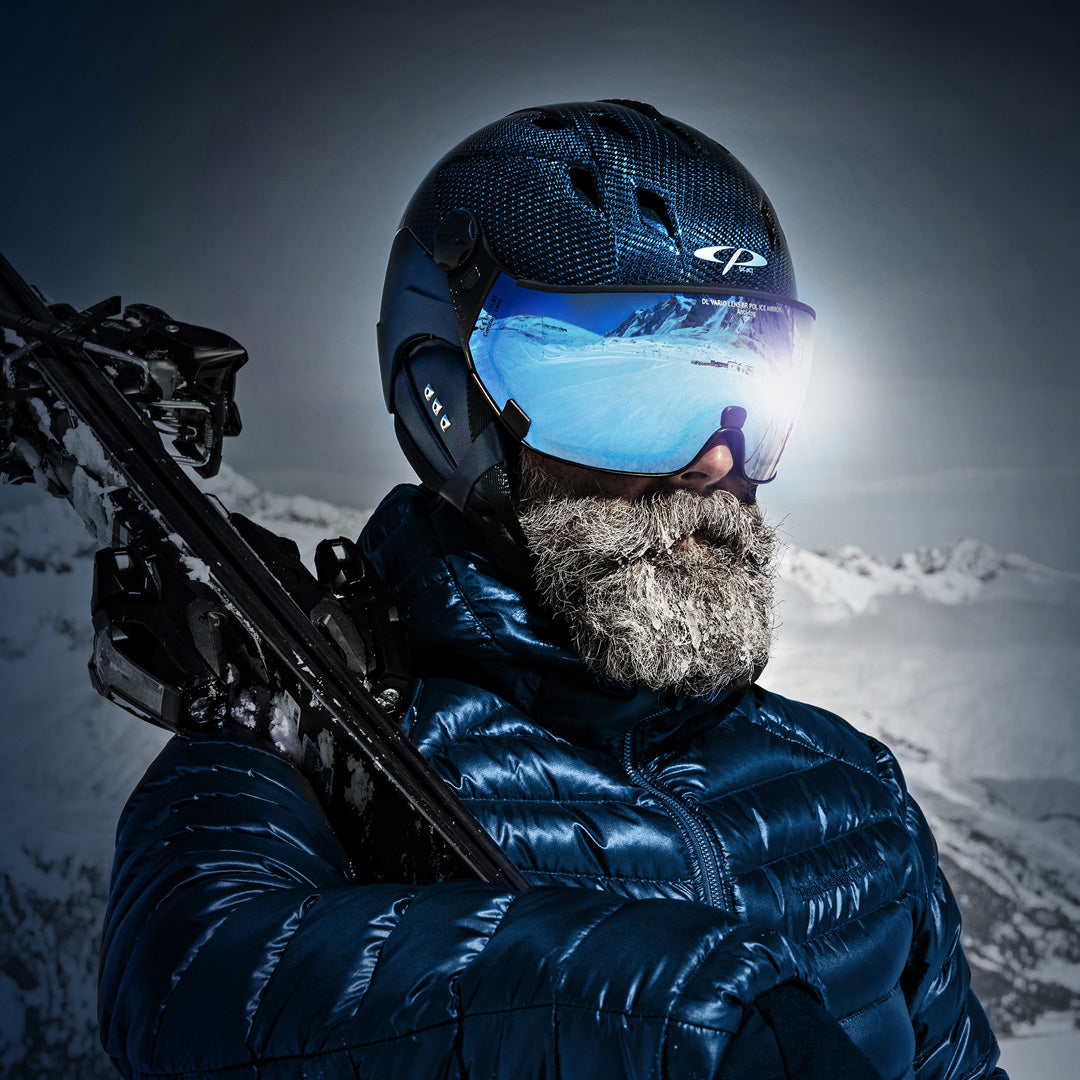
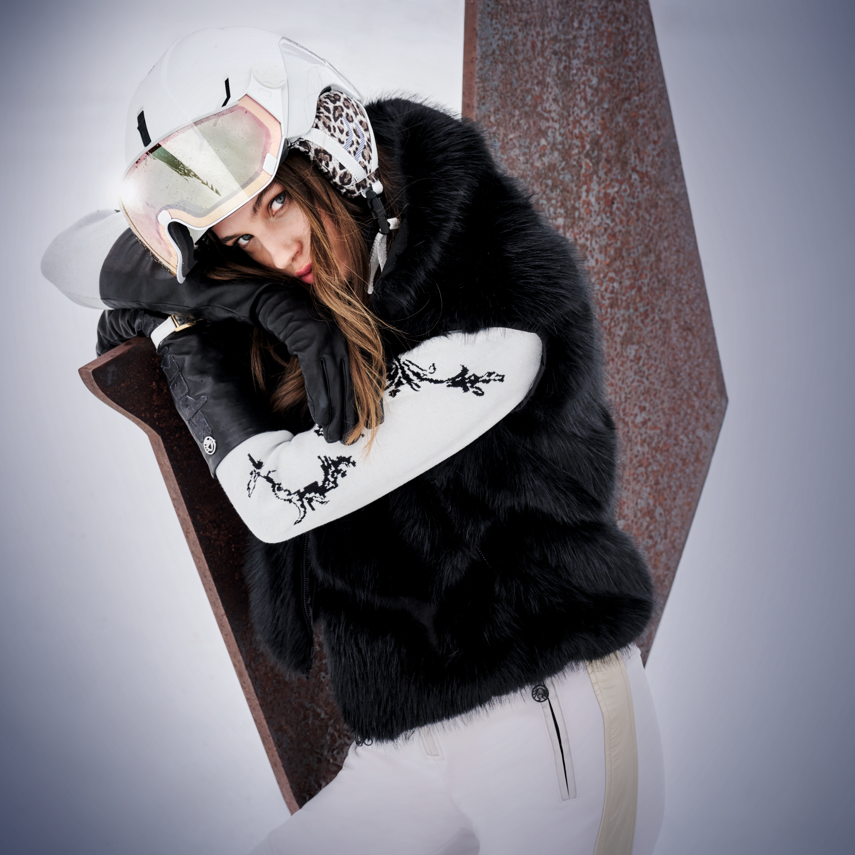
A ski helmet with a visor combines the helmet and ski goggles into one comfortable unit. This not only creates a clean look but also offers several practical advantages over the classic combination of a ski helmet and goggles.
Ideal for glasses wearers
A major advantage of a visor helmet is the high level of comfort for those who wear glasses. You can comfortably wear your own prescription glasses under the visor. This eliminates the need to search for a pair of ski goggles that provides enough space for your corrective eyewear.
No classic ski goggles, less pressure on the face
While classic ski goggles are pressed directly against the face by the frame and strap, the visor does not sit on the face in the same way. This results in a more pleasant and less restrictive wearing experience.
Another benefit becomes apparent after skiing or when taking a break in a restaurant: due to the lower direct pressure in the facial area, the typical marks left by tightly fitting goggles can be reduced—a comfort and design aspect that many skiers particularly appreciate.
Generous field of vision
Thanks to the large visor lens, a visor helmet offers a generous field of vision. This allows you to perceive your surroundings and the terrain comfortably, without a classic goggle frame unnecessarily restricting your view.
More facial coverage
The large-area visor covers a greater area around the eyes and the upper face. As a result, it provides additional protection against wind, snow, and changing weather conditions on the slopes.
Helmet and visor perfectly coordinated
With a visor helmet, the helmet and visor form a perfectly matched system. You do not need separate ski goggles and do not have to worry about whether your helmet and goggles harmonize in terms of fit and aesthetics.
A ski helmet with a visor is therefore particularly interesting for anyone who wants to combine high wearing comfort, a generous field of vision, and a clean look—and is a comfortable alternative to classic ski goggles, especially for glasses wearers.
Why a carbon helmet has advantages
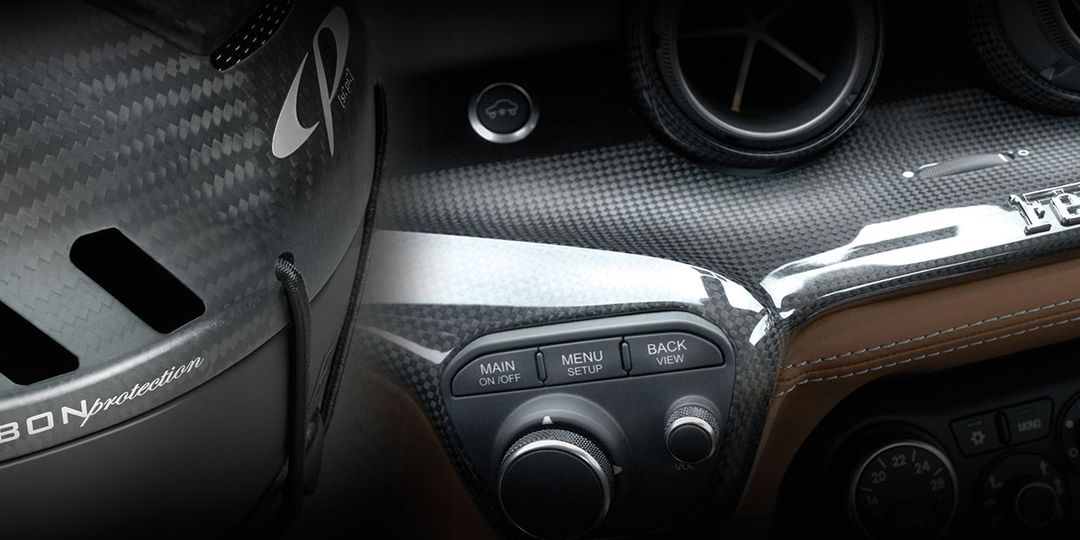
Carbon is a high-tech material used wherever low weight, high strength, and high-quality workmanship are required – for example, in motorsports, aviation, or professional cycling. These properties also make carbon particularly attractive for high-end ski helmets.
Low weight with high strength
One of the greatest advantages of carbon is its excellent strength-to-weight ratio. Carbon fibers enable very lightweight yet stable constructions. For a ski helmet, this allows for the creation of a high-quality outer shell with low weight.
High wearing comfort
Especially during a long day of skiing, every gram counts. A lightweight ski helmet places less strain on the head and neck, which can contribute to a comfortable feeling over many hours.
High-quality and elaborate workmanship
Manufacturing a carbon shell is significantly more complex than for many conventional helmet shells. Processing carbon material requires precision and experience. As a result, carbon is particularly attractive for premium helmets, where material, workmanship, and weight play a central role.
Unique carbon look
In addition to its technical properties, carbon has a distinctive surface structure. The visible fiber structure gives every carbon helmet a technical and exclusive character, making the material visually special as well.
Carbon at CP
With our CP carbon helmets, we combine a high-quality carbon outer shell with the comfort and features of our premium visor helmets. The result is an especially lightweight and high-end ski helmet for those who do not want to compromise on material, workmanship, or design.
A carbon ski helmet is therefore the right choice if you are looking for a lightweight premium ski helmet with a high-quality material aesthetic and a characteristic carbon look. Click here for our carbon helmets
When should a ski helmet be replaced
Even a high-quality ski helmet does not have an unlimited lifespan. We recommend replacing a ski helmet after about 5 to 7 years of normal use. As time goes on, the properties of the plastics and cushioning materials used can change.
Why does a ski helmet age?
A ski helmet is exposed to various influences during its lifespan. UV radiation, cold, heat, moisture, and extreme temperature fluctuations can contribute to the natural aging of the materials. Over time, plastics can lose plasticizers, among other things, and become more brittle as a result. This material aging is not always visible from the outside.
The helmet should be replaced after a strong impact
After a serious fall or a strong impact, we recommend replacing the ski helmet – even if there is no visible external damage. The shock-absorbing materials inside the helmet can be stressed or permanently deformed during an impact without this being visible from the outside.
Check your helmet regularly
Regardless of its age, you should regularly check your ski helmet for visible damage. Cracks, deformations, damaged fastenings, or other noticeable changes may be an indication that the helmet should be replaced.
As a guide, we therefore recommend: Replace your ski helmet after about 5–7 years and always replace it after a serious impact. This ensures that you are not relying on a helmet whose material properties could be impaired by aging or a previous fall.